When Turkish Literature Meets History: 4 Surprising Stories
Turkish language and literature graduate
Sometimes a prison cell creates a novelist. Sometimes a poem sends its writer far from home. Here are four true stories where Turkish literature meets history.
1. Introduction
In 1951, a poet lost his own country. The government took away his citizenship. His name was Nâzım Hikmet. Years before, he had written one of the most powerful poems about Turkey's War of Independence. He got his citizenship back only in 2009, 58 years later, and long after he had died.
This is a big part of the story of Turkish literature. Writers did not only write about history. Very often, they lived inside it. They paid a price for it, or they met someone by chance who changed their life.
In this article, we look at four surprising moments where Turkish literature and history meet. Some are pure coincidence. Some are sad twists of fate. All of them are true and much more interesting than any schoolbook.
Why do literature and history go together in Turkey?
In the last hundred years, Turkey saw huge changes. An empire fell. A war of independence was fought. A new republic was born. In times like these, a writer is not just watching from far away. Very often, the writer is right in the middle of it.
That is why many famous Turkish writers are also witnesses to history. Some were on the battlefield. Some were in prison. Some were in a courtroom. Here are four of the most surprising examples.
A novel written at the front: Halide Edib and Ateşten Gömlek
In 1919, a huge crowd filled Sultanahmet Square in Istanbul to protest the occupation of the city. The person who gave a powerful speech to the crowd was a novelist: Halide Edib Adıvar.
One year later, she crossed to Anatolia and joined the army during the War of Independence. She did not see the war from the outside. She saw it from the inside, and she rose from corporal (onbaşı) to sergeant (başçavuş).
Her novel Ateşten Gömlek (The Shirt of Flame) came from this experience:
It was published in parts in the İkdam newspaper in the summer of 1922, while the war was still going on.
It is known as one of the first Turkish novels about the War of Independence.
It tells the story of the real people and the real feelings she saw at the front.
A small coincidence: the name “shirt of fire” was born in a chat with another writer, Yakup Kadri. He said he wanted to write a novel with that title. Halide Edib loved the words so much that she used them for her own book.
A chance meeting in prison: Nâzım Hikmet and Orhan Kemal
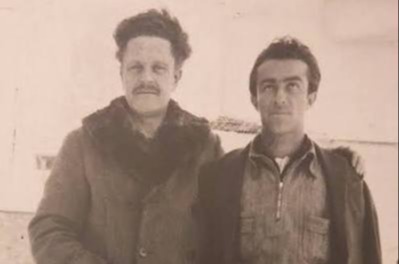
Winter 1940, Bursa Prison. A young prisoner writes poems, but he has not found his own voice yet. He is waiting, full of excitement, for a famous man who is coming to his cell. That man is Nâzım Hikmet, one of Turkey's greatest poets. The young prisoner is Orhan Kemal, who later became a famous writer too.
They meet in the same cell. Nâzım does not really like Orhan Kemal's poems. But then he reads a piece of his prose and finds it very good. So he gives him clear advice: stop writing poems, and write novels instead.
This small push changed the path of Turkish literature:
Orhan Kemal left poetry and moved to prose.
Classics like Bereketli Topraklar Üzerinde, Murtaza and Ekmek Kavgası came from this change.
Their bond grew from teacher and student into something like father and son. When Orhan Kemal's son was born in 1944, he gave him the name “Nâzım,” just as the poet asked.
And Nâzım's “prison school” was not only for Orhan Kemal. The writer Kemal Tahir and the painter İbrahim Balaban learned from him too. So one of Turkey's best writing workshops was born inside a prison cell.
The poet who wrote the war's great poem and lost his country
In 1921, when he was still very young, Nâzım Hikmet crossed to Anatolia and saw the energy of the national struggle up close. However, he wrote his great poem about the War of Independence, Kuvâyi Milliye, in the most surprising place of all: in prison.
He started the poem in 1939 and finished it in 1941, in Bursa Prison. He had not lived the details of the war himself, so he used documents. A relative of his, the war commander Ali Fuat Cebesoy, gave him sources. The result was one of the strongest poems in the Turkish language, a poem about the courage of ordinary people such as drivers, villagers and women. Even so, the full poem could not be published for a long time. It reached readers only in the mid-1960s.
Here is the sad part. The poet who wrote the founding poem of the Republic was removed from Turkish citizenship in 1951. He died in Moscow in 1963, and his grave is still there. His citizenship came back only in 2009, 58 years later.
Words on trial: Orhan Pamuk and Elif Şafak
You might think the fight between a writer and the state belongs only to Nâzım's time. However, the same tension came back in the 2000s.
Pamuk: from court to the Nobel Prize
In 2005, in an interview with a Swiss magazine, Orhan Pamuk spoke about parts of history that people in Turkey had not talked about openly for a long time. Because of these words, he was taken to court under a law called Article 301, for “insulting Turkishness.” The case was dropped in January 2006.
Then, in October of the same year, something surprising happened: Pamuk won the Nobel Prize in Literature. He was the first Turkish person ever to win it. So, in just a few months, the same writer was accused of “insulting Turkishness” and also gave his country its first Nobel Prize. When he won, he said the prize was not only for him but for Turkey too.
Şafak: on trial for a character in a novel
Elif Şafak's novel Baba ve Piç (The Bastard of Istanbul) became a bestseller in 2006. But Şafak was also put on trial under the same Article 301, because of words spoken by characters in her novel, people she had invented, not real people. In a way, the story itself was on trial.
Şafak was found not guilty in autumn 2006, in a single hearing. (She was not even in the courtroom that day, because she had just had a baby.)
A lot changed in one hundred years. One thing did not change: when literature touches history, society and power, it always makes a spark.
Conclusion: coincidence, or fate?
A prison cell created a novelist. A poem sent its writer far from home. A court case and a Nobel Prize happened in the same year. We can call these coincidences. But they all share one thing: in Turkey, literature has never stood far from history.
Writers became the memory of this land. Sometimes they paid a heavy price. Sometimes the very words they paid for made them unforgettable. Maybe this is what makes Turkish literature so strong. It was written in the middle of history within the history.
So, which story surprised you the most? These writers used Turkish at its most powerful, and you can use real, living Turkish too. Chat with Turkish characters in Roleplay to practise at your own level, or train your ear on real scenes with TV Together. 📚
Learn the words: Turkish literature vocabulary
Love books? Here are some useful Turkish words from these stories. Most of them are about literature, writers and history, perfect for reading more Turkish one day.
Turkish | English |
|---|---|
edebiyat | literature |
şair | poet |
yazar | writer |
roman | novel |
romancı | novelist |
şiir | poem, poetry |
destan | epic |
vatan | homeland |
vatandaşlık | citizenship |
cezaevi / hapishane | prison |
mahkeme | court |
ödül | prize, award |
tesadüf | coincidence |
Try one in a sentence today. For example: Nâzım Hikmet büyük bir şair. (Nâzım Hikmet is a great poet.)
Further reading
Orhan Kemal, In Jail with Nâzım Hikmet (Turkish: Nâzım Hikmet'le Üç Buçuk Yıl) - the story of their prison friendship, told by the person who lived it.
Nâzım Hikmet, Kuvâyi Milliye - the War of Independence poem itself.
Halide Edib Adıvar, Ateşten Gömlek, and her memoir The Turkish Ordeal (Turkish: Türk'ün Ateşle İmtihanı) - from a novelist who was at the front.